
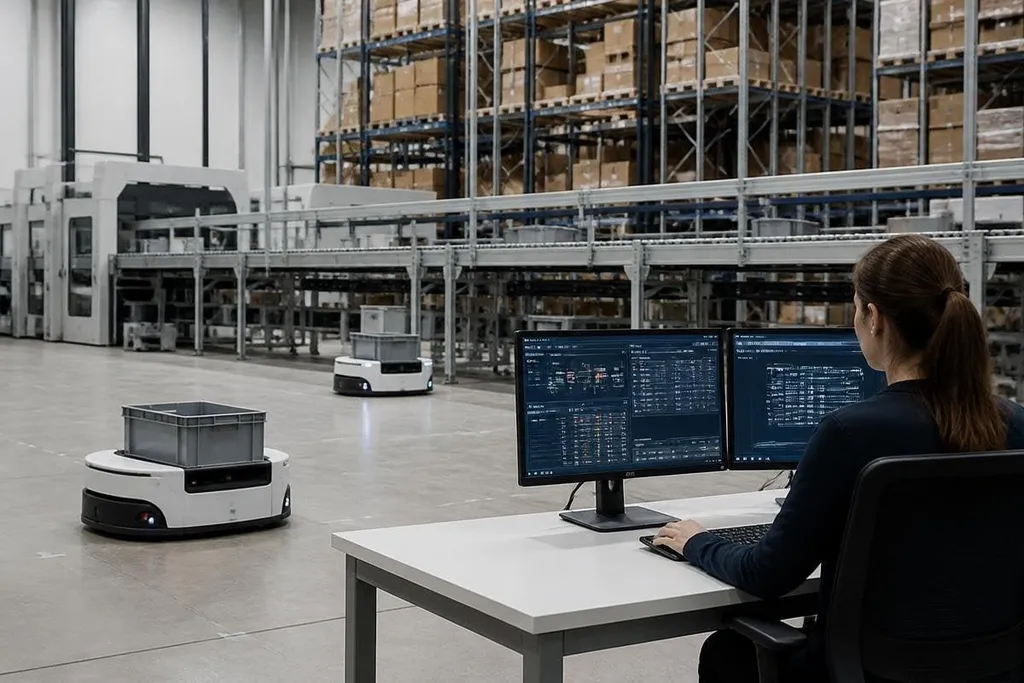
A fully automated warehouse would receive goods, store them, pick orders, pack cartons, and send them out with no routine human work inside the building. The machines exist for many of those jobs, but normal use depends on how well the systems handle change, faults, and safety.
- Automation works best when goods, orders, and routes stay predictable.
- People still need to manage exceptions, repairs, safety, and stock problems.
- A better test is the number of human interventions per shift, not the number of robots installed.
What full automation would need to handle
A warehouse has several linked jobs. Its warehouse management system records stock and orders. Conveyors move containers between work areas. Autonomous mobile robots carry shelves or totes.
Robotic arms pick items, place them in cartons, and pass them to shipping. Each part can work on its own. The hard part is keeping the whole chain running when one part stops.
A blocked conveyor can leave a picking station without stock. A failed barcode scan can send the wrong tote to an arm. A damaged carton can stop a packing cell until someone clears it.
That means full automation needs more than robots. It needs sensors, software, spare parts, charging systems, safety-rated scanners, and a clear way to handle work that does not fit the rules.
The human work moves to exceptions
A person may not need to pick every order in a highly automated site. They may still need to check a crushed box, remove a jam, approve a stock correction, or guide a vehicle around a blocked aisle.
This work is easy to ignore because it sits outside the normal task flow. It also decides whether the warehouse keeps running after a fault. A system that completes routine picks for hours but needs a person for every unusual item has a different staffing need from one that can recover on its own.
The useful measure is therefore human intervention. A warehouse operator should ask how many stops happen in a shift, how long each stop lasts, and which faults need a trained technician. Those figures show more than a robot count.
For a warehouse manager comparing deployments, warehouse automation reporting from Robot24.com can tie each claim to the named robot, site, task, and measured result. Those details help you spot a plan that depends on people rescuing the system before it reaches the first serious fault.
Where the plan can break
Product variety is one pressure point. A robot arm can repeat a known pick path with care, while an item with a soft bag, damaged label, or unusual shape may need a new grasp plan.
Order patterns also change. A system built for steady demand may need different routes and storage rules during a short sales rush. If software cannot adjust without a long restart, the warehouse may need people at the exact time orders rise.
Safety adds another limit. Vehicles, arms, conveyors, and people share space in many facilities. Sensors must detect a person or object, stop the right machine, and let work resume after the area is safe. The full chain needs testing at the speed and layout used on site.
Cost matters after installation, too. A buyer has to count power, software fees, service contracts, replacement parts, technician time, and downtime. A lower headcount does not settle the case if one fault can stop several work areas.
A practical decision guide
Before calling a warehouse fully automated, check these points:
- Map the exceptions: List damaged goods, unreadable labels, empty locations, jams, and unusual orders.
- Time each recovery: Record how long a person needs to restore normal work after every fault.
- Check the handoffs: Trace one item through receiving, storage, picking, packing, and dispatch.
- Price the support layer: Include technicians, spare parts, software, power, training, and planned downtime.
- Test the busy period: Run the system with the highest expected order mix, not a clean demo flow.
A site that passes these checks may use very few people inside its main work areas. It still needs people who can fix equipment, change rules, manage safety, and deal with goods the software cannot classify.
I'd wait before calling any warehouse fully automated unless its operator can publish exception rates and recovery times from daily work. The next useful proof is simple: how many human interventions does one shift need, and how long does each one take?